Discover the best stretching exercises for flexibility and pain relief at home. Expert guide to back pain, hip stretches, and daily routines.

Here’s something I wish someone had told me in my twenties: that stiff, achy feeling you get when you roll out of bed? It’s not just “getting older.” It’s your body literally begging you to stretch.
I learned this the hard way after spending years hunched over a laptop, ignoring every twinge and tight muscle until one morning I couldn’t turn my head without wincing. My back felt like someone had replaced my spine with a rusty hinge. My hips? Frozen solid. That was my wake-up call.
The beautiful thing about stretching is this: it’s free, it requires zero equipment (though a few tools help), and you can do it anywhere—including your living room in your pajamas while watching Netflix. And unlike most health advice that promises results “eventually,” stretching gives you almost immediate relief.
Let me show you the stretching exercises that actually work for flexibility and pain relief, backed by both science and the hard-earned wisdom of someone who went from “I can’t touch my toes” to “I can actually tie my shoes comfortably.”
Why Stretching Matters More Than You Think
Before we dive into specific exercises, let’s talk about why flexibility and stretching deserve a spot in your daily routine—right up there with brushing your teeth.
Flexibility directly impacts pain. Tight muscles pull on your joints and spine, creating compensatory patterns that lead to chronic pain. That lower back ache? Often it’s tight hamstrings and hip flexors pulling everything out of alignment.
Your body is designed to move. Modern life—sitting at desks, driving cars, staring at phones—keeps us locked in the same positions for hours. Your muscles adapt by shortening and tightening, which is why you feel like the Tin Man after a long workday.
Stretching improves circulation. Better blood flow means more oxygen and nutrients to your muscles, faster recovery from workouts, and reduced inflammation.
It’s preventative medicine. Regular stretching prevents injuries, maintains joint health, and can literally slow down the physical effects of aging. Seriously—the difference in mobility between someone who stretches daily and someone who doesn’t is stark by age 50.
Think of stretching as regular maintenance for your body. You wouldn’t skip oil changes for your car, right? Same principle.
Understanding Static vs. Dynamic Stretches for Pain Relief
Not all stretches are created equal, and timing matters. Let me break down the two main types:
Static Stretches
These are the classic “hold and breathe” stretches where you ease into a position and maintain it for 15-60 seconds. Static stretching is incredible for:
Improving overall flexibility and range of motion. Relieving muscle tension and chronic pain. Cooling down after workouts. Evening relaxation routines.
Best practices:
- Hold each stretch 15-60 seconds
- Never bounce—ease into the stretch gradually
- Breathe deeply and relax into it
- Repeat 2-3 times per stretch
Dynamic Stretches
These involve movement—controlled, gentle motions through your full range of motion. Think leg swings, arm circles, torso twists. Dynamic stretching is perfect for:
Warming up before exercise or sports. Morning routines to wake up your body. Improving functional mobility.
Best practices:
- Perform 10-15 repetitions per movement
- Keep movements controlled and smooth
- Gradually increase range of motion
- Focus on major muscle groups you’ll use
Here’s the general rule: Dynamic stretching before activity, static stretching after activity or for pure flexibility/pain relief work.
For pain relief specifically, static stretches are your best friend. They target the tight, painful areas and give your nervous system time to relax and release tension.
The Best Stretching Exercises for Back Pain and Flexibility
Back pain is the silent epidemic of modern life. Nearly 80% of adults experience it at some point. Let me show you the stretches that actually provide relief.
1. Cat-Cow Stretch (Spinal Mobility)
This yoga-based movement gently mobilizes your entire spine and relieves tension.
How to do it:
- Start on hands and knees (tabletop position) on a Manduka PRO Yoga Mat
- Inhale, drop belly, lift chest and tailbone (cow)
- Exhale, round spine, tuck chin and tailbone (cat)
- Flow between positions for 1-2 minutes
- Focus on smooth, controlled movement
This one feels like a massage for your spine. I do it every morning before coffee.
2. Child’s Pose (Lower Back Release)
One of the most therapeutic stretches for lower back pain, child’s pose gently stretches your entire back chain.
How to do it:
- Kneel on floor, big toes touching, knees apart
- Sit hips back toward heels
- Extend arms forward, forehead to floor
- Hold 1-3 minutes, breathing deeply
- Use Gaiam Yoga Blocks under your forehead if you can’t reach the floor
This stretch is your sanctuary. When my back is screaming, this is where I live.
3. Knee-to-Chest Stretch (Lower Back and Glutes)

Simple but incredibly effective for relieving lower back tension and sciatica pain.
How to do it:
- Lie on your back
- Draw one knee toward your chest with both hands
- Keep opposite leg extended or bent (whatever feels better)
- Hold 30-60 seconds
- Switch sides, then pull both knees to chest
4. Seated Spinal Twist (Thoracic Mobility)
Perfect for desk workers with mid-back tightness and poor rotation.
How to do it:
- Sit on floor, legs extended
- Bend right knee, place foot outside left thigh
- Place left elbow outside right knee
- Twist gently to the right, looking over shoulder
- Hold 30-60 seconds, breathe deeply
- Switch sides
Pro tip: Use a Stretch Strap Yoga Accessory to help maintain proper form if flexibility is limited initially.
since your showing interest in stretching then “Morning Workout Benefits” relevant blog
Hip Stretches for Flexibility and Lower Back Pain Relief
Your hips are the foundation of lower back health. Tight hips pull on your lumbar spine, creating that nagging lower back pain. Let’s fix it.
1. Pigeon Pose (Deep Hip Opener)
This yoga pose is intense but absolutely transformative for hip flexibility and pain relief.
How to do it:
- Start in downward dog or tabletop
- Bring right knee forward, placing it behind right wrist
- Extend left leg straight back
- Square your hips, fold forward over front leg
- Hold 1-3 minutes (yes, really—breathe through it)
- Switch sides
The first time you do this, you might hate me. By week three, you’ll thank me. The Liforme Yoga Mat with alignment markers helps you position correctly.
2. Figure-4 Stretch (Hip and Glute Release)
Also called the reclined pigeon, this is a gentler version that’s perfect for beginners or those with knee issues.
How to do it:
- Lie on your back
- Cross right ankle over left thigh
- Pull left thigh toward chest with both hands
- Feel the stretch in right hip and glute
- Hold 30-60 seconds
- Switch sides
This one is gold for sciatica pain relief.
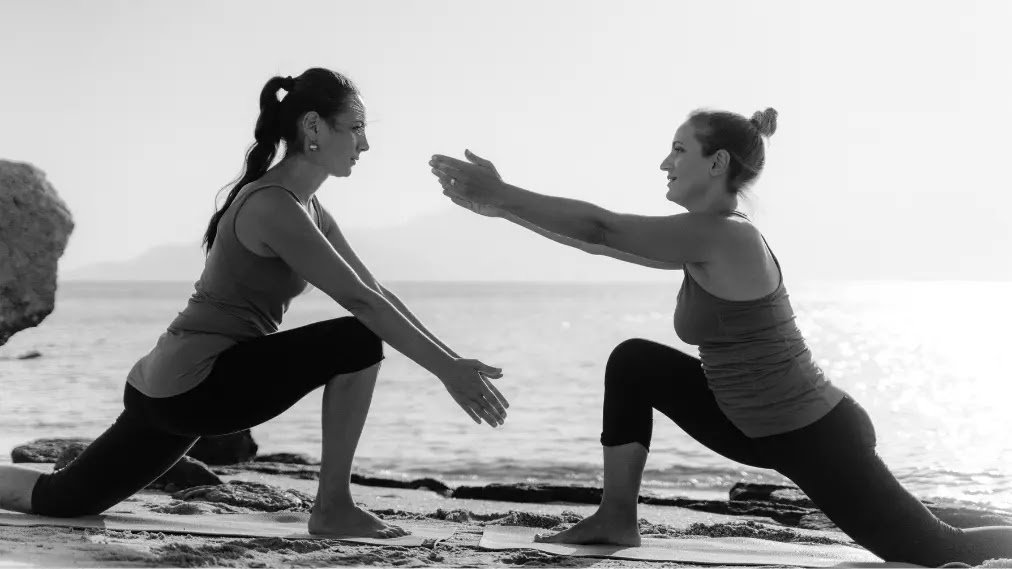
3. Hip Flexor Stretch (Kneeling Lunge)
Sitting all day shortens your hip flexors, pulling your pelvis forward and straining your lower back. This stretch reverses the damage.
How to do it:
- Kneel on right knee, left foot forward (lunge position)
- Keep torso upright, engage core
- Push hips forward gently until you feel stretch in right hip flexor
- Hold 30-60 seconds
- Switch sides
Use a folded towel or Yes4All Yoga Blocks under your knee for comfort on hard floors.
4. Butterfly Stretch (Inner Thigh and Hip Mobility)
Opens your hips and groin while relieving tension throughout your hip complex.
How to do it:
- Sit with soles of feet together, knees dropping to sides
- Hold feet, sit tall
- Gently press knees toward floor with elbows
- For deeper stretch, fold forward from hips
- Hold 1-2 minutes
Hamstring Stretches for Knee Pain and Flexibility
Tight hamstrings are sneaky troublemakers—they contribute to knee pain, lower back pain, and poor posture. Let’s loosen them up.
1. Standing Forward Fold (Full Posterior Chain)
A classic yoga pose that stretches your entire back body from calves to hamstrings to spine.
How to do it:
- Stand with feet hip-width apart
- Hinge at hips, folding forward
- Let arms hang, relax your neck
- Bend knees slightly if hamstrings are very tight
- Hold 1-2 minutes, breathing deeply
Don’t worry about touching your toes. That’s not the goal. The goal is feeling the stretch and breathing into it.
2. Seated Hamstring Stretch with Strap
Using a Bobo Bird Yoga Strap allows you to stretch deeper while maintaining proper alignment.
How to do it:
- Sit with legs extended
- Loop strap around one foot
- Hold both ends of strap
- Keep back straight, hinge from hips
- Pull gently on strap to deepen stretch
- Hold 30-60 seconds per leg
3. Reclined Hamstring Stretch (Gentle and Effective)
Perfect for people with back issues who can’t comfortably do seated stretches.
How to do it:
- Lie on your back
- Lift one leg, keeping it straight
- Use hands behind thigh or a strap around foot
- Pull leg gently toward chest
- Keep opposite leg extended on floor
- Hold 30-60 seconds per leg
Shoulder Stretches for Flexibility and Pain Relief

Shoulder pain and limited mobility are hallmarks of modern life—thanks, smartphones and laptops. These stretches restore function and eliminate pain.
1. Thread the Needle (Shoulder and Upper Back)
This stretch targets the often-neglected area between your shoulder blades.
How to do it:
- Start on hands and knees
- Reach right arm under left arm, threading it through
- Right shoulder and ear rest on mat
- Left arm can extend forward or rest on back
- Hold 30-60 seconds
- Switch sides
2. Doorway Chest Stretch (Pec Release)
Tight chest muscles pull your shoulders forward, creating rounded posture and shoulder pain.
How to do it:
- Stand in doorway, forearm against door frame
- Step forward with same-side leg
- Lean forward until you feel stretch across chest
- Hold 30-60 seconds
- Vary arm height (low, middle, high) to hit different areas
- Repeat on other side
3. Cross-Body Shoulder Stretch
Simple but effective for shoulder flexibility and rotator cuff health.
How to do it:
- Bring right arm across your body at chest height
- Use left hand to gently pull right arm closer
- Keep shoulders down and relaxed
- Hold 30 seconds
- Switch sides
Full-Body Stretching Routine for Chronic Pain
Here’s a complete 15-minute routine that addresses all major problem areas. Do this daily for maximum benefit.
Equipment needed:
- Yoga mat (Jade Harmony Yoga Mat or BalanceFrom GoYoga Mat)
- Optional: blocks, strap, foam roller
Morning Flexibility Routine (15 minutes)
| Exercise | Duration | Target Area |
|---|---|---|
| Cat-Cow | 1-2 min | Spine mobility |
| Child’s Pose | 1-2 min | Lower back |
| Downward Dog | 1 min | Full back body |
| Hip Flexor Lunge | 1 min each | Hip flexors |
| Pigeon Pose | 1 min each | Deep hip openers |
| Seated Forward Fold | 1-2 min | Hamstrings, back |
| Spinal Twist | 30 sec each | Spine rotation |
| Thread the Needle | 30 sec each | Shoulders |
| Figure-4 Stretch | 30 sec each | Hips, glutes |
| Final Relaxation | 1-2 min | Integration |
Total time: 15 minutes
Evening Pain Relief Routine (10 minutes)
Focus on static holds and deep breathing for tension release:
- Foam rolling (TriggerPoint Foam Roller): 2 minutes on tight areas
- Child’s Pose: 2 minutes
- Figure-4 Stretch: 1 minute each side
- Knee-to-Chest: 1 minute each side
- Spinal Twist: 1 minute each side
- Legs up the wall: 2 minutes for circulation and relaxation
How Long Should You Hold Stretches?
This is one of the most common questions, and the answer depends on your goal.
For pain relief and flexibility gains:
- Hold static stretches 30-60 seconds minimum
- Some deep stretches (like pigeon pose) benefit from 1-3 minutes
- Repeat each stretch 2-3 times if possible
Why so long? Your muscles have protective mechanisms (stretch reflex) that initially resist lengthening. After about 30 seconds, these mechanisms relax, allowing deeper, more effective stretching.
Research shows: Holding stretches for 30-60 seconds produces optimal flexibility gains without increasing injury risk. Longer isn’t necessarily better—beyond 60 seconds, you get diminishing returns for most stretches.
For dynamic stretching (warm-ups):
- Perform 10-15 repetitions per movement
- Each repetition takes 1-2 seconds
- Total time: 30-60 seconds per exercise
How Often Should You Stretch for Flexibility Gains?
Consistency trumps intensity when it comes to flexibility.
For significant flexibility improvements:
- Stretch 5-7 days per week
- 15-30 minutes per session
- Focus on problem areas daily
For maintenance:
- 3-4 days per week minimum
- 10-15 minutes per session
Real talk: Daily stretching is ideal, but if you can only manage 3-4 days, you’ll still see improvements. The key is consistency over weeks and months, not perfection.
I aim for 15 minutes every morning. Some days I manage it, some days I don’t. But hitting that target 5-6 days per week has transformed my flexibility and eliminated chronic pain.
Stretches for Specific Pain Conditions

Let’s address common pain issues and the stretches that specifically help.
For Sciatica Pain Relief
Sciatica—that shooting pain down your leg—responds incredibly well to targeted stretching:
- Pigeon pose (1-2 min each side)
- Figure-4 stretch (1 min each side)
- Seated spinal twist (1 min each side)
- Knee-to-chest (1 min each side)
Do this sequence 2-3 times daily during flare-ups. Use a Hyperice Venom 2 Back Wrap for heat therapy alongside stretching.
For Knee Pain and Flexibility
Knee pain often stems from tight quads, hamstrings, and IT bands:
- Quad stretch (standing or lying: 30 sec each)
- Hamstring stretches (various positions: 1 min each)
- IT band stretch (side-lying or standing: 1 min each)
- Calf stretches (wall stretch: 30 sec each)
A Pro-Tec Athletics Knee Strap provides support during stretching if you have existing knee issues.
For Neck Tension and Flexibility
Tech neck and desk work create chronic neck tension:
- Neck side bends (ear to shoulder: 30 sec each)
- Neck rotation (look over shoulder: 30 sec each)
- Chin tucks (10-15 reps)
- Upper trap stretch (gentle pull: 30 sec each)
Combine with using a Yoga Tune Up Therapy Ball or ProsourceFit Lacrosse Ball to release trigger points in shoulders and neck.
Beginner-Friendly Stretching Mistakes to Avoid
Let me save you from the mistakes I made when starting:
Mistake #1: Bouncing during static stretches. This triggers the stretch reflex and can cause injury. Ease into stretches smoothly and hold steady.
Mistake #2: Holding your breath. Deep breathing is crucial. It signals your nervous system to relax and allows muscles to lengthen. Breathe in through nose, out through mouth.
Mistake #3: Pushing through sharp pain. Stretching should feel like gentle pulling or mild discomfort, never sharp or stabbing pain. If it hurts sharply, back off immediately.
Mistake #4: Stretching cold muscles. Do light movement (walking, arm circles) for 5 minutes before deep stretching, or stretch after warm showers.
Mistake #5: Inconsistency. Stretching once a week won’t do much. Daily practice (even just 10 minutes) produces real results.
Mistake #6: Ignoring alignment. Proper form matters. Using tools like Liforme Yoga Mat with alignment guides or Gaiam Cork Yoga Block helps maintain correct positioning.
Mistake #7: Expecting instant results. Flexibility develops over weeks and months, not days. Be patient and consistent.
Essential Stretching Tools Worth Having
You don’t need equipment to stretch, but a few key items make everything easier and more effective:
Must-haves ($50-100):
- Quality yoga mat (Manduka PRO Yoga Mat or Jade Harmony Yoga Mat: $60-120)
- Yoga blocks (Gaiam Yoga Blocks Set: $15-25)
- Stretching strap (Bobo Bird Yoga Strap: $10-15)
Nice-to-haves ($100-200):
- Foam roller (TriggerPoint Foam Roller: $30-50)
- Massage balls (Yoga Tune Up Therapy Ball set: $20-30)
- Resistance bands (Theraband Resistance Bands Set: $20-40)
Investment pieces (if budget allows):
- Yoga wheel (Froliq Yoga Wheel: $40-60)
- Heated therapy wrap (Hyperice Venom 2 Back Wrap: $150-200)
- Acupressure mat set (Acupressure Mat and Pillow Set: $30-50)
Start with just a mat and blocks. Add other tools as you develop your practice.
Can Daily Stretching Prevent Age-Related Flexibility Loss?
Short answer: absolutely yes.
The decline in flexibility with age isn’t inevitable—it’s largely the result of inactivity and accumulated compensatory patterns. Research shows that older adults who stretch regularly maintain flexibility similar to people decades younger.
What happens if you don’t stretch:
- Muscles naturally shorten and stiffen with age
- Range of motion decreases progressively
- Risk of injury increases
- Daily activities become more difficult
- Balance and coordination suffer
What happens when you do stretch consistently:
- You maintain or even improve range of motion
- Joint health is preserved
- Pain decreases or disappears
- You maintain independence longer
- Overall quality of life improves significantly
I’ve seen 70-year-olds who stretch daily move better than sedentary 40-year-olds. The difference is stark and entirely within your control.
Your 30-Day Stretching Challenge
Ready to commit? Here’s a progressive 30-day plan to build your stretching habit and see real results.
Week 1: Foundation (10 min daily)
Focus on basic stretches, learning proper form:
- Cat-Cow: 2 minutes
- Child’s Pose: 2 minutes
- Hip Flexor Lunge: 1 min each
- Hamstring Stretch: 1 min each
- Simple Spinal Twist: 1 min each
Week 2: Building (15 min daily)
Add depth and variety:
- Previous routine
- Plus: Pigeon Pose (1 min each)
- Plus: Shoulder stretches (2 minutes total)
- Plus: Figure-4 Stretch (1 min each)
Week 3: Expanding (20 min daily)
Increase hold times and add new stretches:
- Full-body routine
- Hold stretches 45-60 seconds
- Add foam rolling or massage ball work
- Experiment with different variations
Week 4: Mastery (20-30 min daily)
Personalize based on your body’s needs:
- Focus on problem areas
- Deepen holds in comfortable stretches
- Add restorative poses
- Develop sustainable routine you’ll continue
Track your progress by testing specific ranges of motion weekly. Can you touch your toes? How far down can you go in pigeon pose? Document these baselines and watch them improve.
Your Action Plan Starting Today
Enough information. Let’s make this happen right now.
Today (within the next hour):
- Clear a small space in your home
- Lay out a mat (or towel if you don’t have a mat yet)
- Do the 10-minute beginner routine from this guide
- Schedule tomorrow’s session in your calendar
This Week:
- Stretch 5 out of 7 days minimum
- Focus on proper form over depth
- Take before photos and measurements
- Order basic equipment if needed (mat, blocks)
This Month:
- Complete the 30-day challenge
- Gradually increase session length to 15-20 minutes
- Track which stretches provide most relief
- Take progress photos and compare
Long-Term (3-6 months):
- Make stretching as automatic as brushing teeth
- Notice dramatic improvements in pain and flexibility
- Adjust routine based on your body’s evolving needs
- Help someone else start their stretching journey
The transformation won’t happen overnight. But if you show up consistently—even for just 10 minutes daily—your body will change. The pain will fade. Your range of motion will expand. You’ll move through life with more ease and less discomfort.
Final Thoughts: Start Where You Are

Look, I’m not going to promise you’ll suddenly be able to do the splits or that all your pain will vanish in a week. That’s not how this works.
What I will promise is this: if you commit to daily stretching—even just 10-15 minutes—you’ll notice a difference within two weeks. Within a month, people might comment that you seem to move differently. Within three months, you’ll wonder how you ever lived without this practice.
Your body wants to move freely. It wants to be pain-free. It’s literally designed for flexibility. You’ve just got to give it the time and attention it needs to remember how.
That stiffness you feel? It’s not permanent. That back pain? It’s not a life sentence. That limited range of motion? It’s changeable.
You don’t need to be a yogi. You don’t need to be naturally flexible. You just need to show up, breathe, and stretch.
Start today. Right now. Don’t wait for Monday or next month or “when you have more time.”
Roll out your mat (or a towel), pick three stretches from this guide, and spend 10 minutes giving your body the care it deserves.
Your future self—the one moving freely and pain-free—is waiting.
Ready to transform your flexibility and eliminate pain? Choose the 10-minute beginner routine from this guide and do it today. Not tomorrow. Today. Your journey starts now.
Authority Bio:
Hi, I’m MACHHINDRA Jadhav — a passionate Health Content Writer with 4+ years of experience in the health and wellness space. I specialize in breaking down complex topics like Disease & Conditions, Fitness, Mental Health, and Nutrition into simple, practical advice you can actually use in your daily life.
My goal is not just to inform, but to empower you to take control of your health naturally and confidently. Every article I write is backed by research, real insights, and a deep commitment to helping people live healthier, stronger, and more balanced lives.
If you’re looking for clear, honest, and actionable health guidance — you’re in the right place.
References
- National Institute of Diabetes and Digestive and Kidney Diseases (NIDDK)
- Mayo Clinic
- World Health Organization (WHO)
“This article is for educational purpose. Always consult your doctor.”